
Project Snapshot
A major private bank was losing its high-net-worth clients' engagement. Many went quiet after their first investment, and account managers had no way to know who needed attention, or when. Leadership asked for a client app. Research relocated the problem: the real gap was the account manager's lack of decision support, and that became what we designed for.
Result
Launched in Q2 2024. Account managers got structured behavioural signals for the first time, outreach shifted from intuition to signal, and dormant VIP clients came back.
+20 %
Increase in VIP engagement frequency
+10 %
Reactivation of dormant clients
Faster
Account manager daily workflow
Problem
The symptoms were easy to list: negative NPS, clients going dormant after their first investment, outreach that landed less and less often. Account managers wanted to reach out at the right moment but were working blind. The CRM held records, not behavioural signals, so deciding who to call and when came down to intuition. That missing signal was the real problem.
From a single brief to a system
Decision 1 - Finding the leverage point
The brief asked for a better client-facing experience, but the interviews kept pointing at the account manager. I asked for two weeks to test the alternative with clients, account managers and C-level stakeholders.
It confirmed the bet: the account manager was the leverage point.
We moved from a client communication tool to a B2B2C system, where everything the client touches generates a signal the account manager can act on.
Decision 2 — From research gaps to features
Research pointed to three structural gaps in the account manager's workflow, and each became a feature:
No behavioural visibility became the AI Consultant
No outreach triggers became Portfolio Alerts.
Thin pre-call context became the Portfolio Intelligence Report.
I ranked the three against signal generation, advisory impact and feasibility. The AI Consultant scored highest and became the anchor the other two feed into.
Decision 3 — One interaction, two purposes
Every client-facing interaction had to do two jobs: give the client a useful experience, and produce structured data the account manager could use. One linear journey couldn't carry both.
So the system became dual-layer: a signal loop connects what the client does to the account manager's CRM view, and the client never sees the handoff.

Solution: The system underneath

The product is a loop
Three client-side interfaces capture behavioural signals as a by-product of genuinely useful moments. Each signal is structured around what an account manager needs — goal, risk, preference — and synced into the CRM. The account manager acts on it, and the outcome feeds the next signal.
The AI captures and structures; the account manager judges and advises. In an AI product, that architecture is the design work — the screens are where it surfaces.
Three interfaces, three decision moments
Feature 1 — AI Consultant
The signal-capture layer: who the client is and what they want. The first version used open text; validation showed vague answers and higher drop-off, so I replaced it with a guided flow.
Account managers told me what actually helps: investment objective, risk priority, asset preference. Every prompt maps to one of the three, so what the client says arrives as a signal they can read.


Feature 2 — Portfolio Alerts
The timing layer: when to reach out. Clients engage most when a market event touches their own holdings, so market movement became the trigger — a relevant reason to talk.
Regulation rules out directive recommendations, so the alert surfaces context, opens the conversation, and hands over to the account manager.

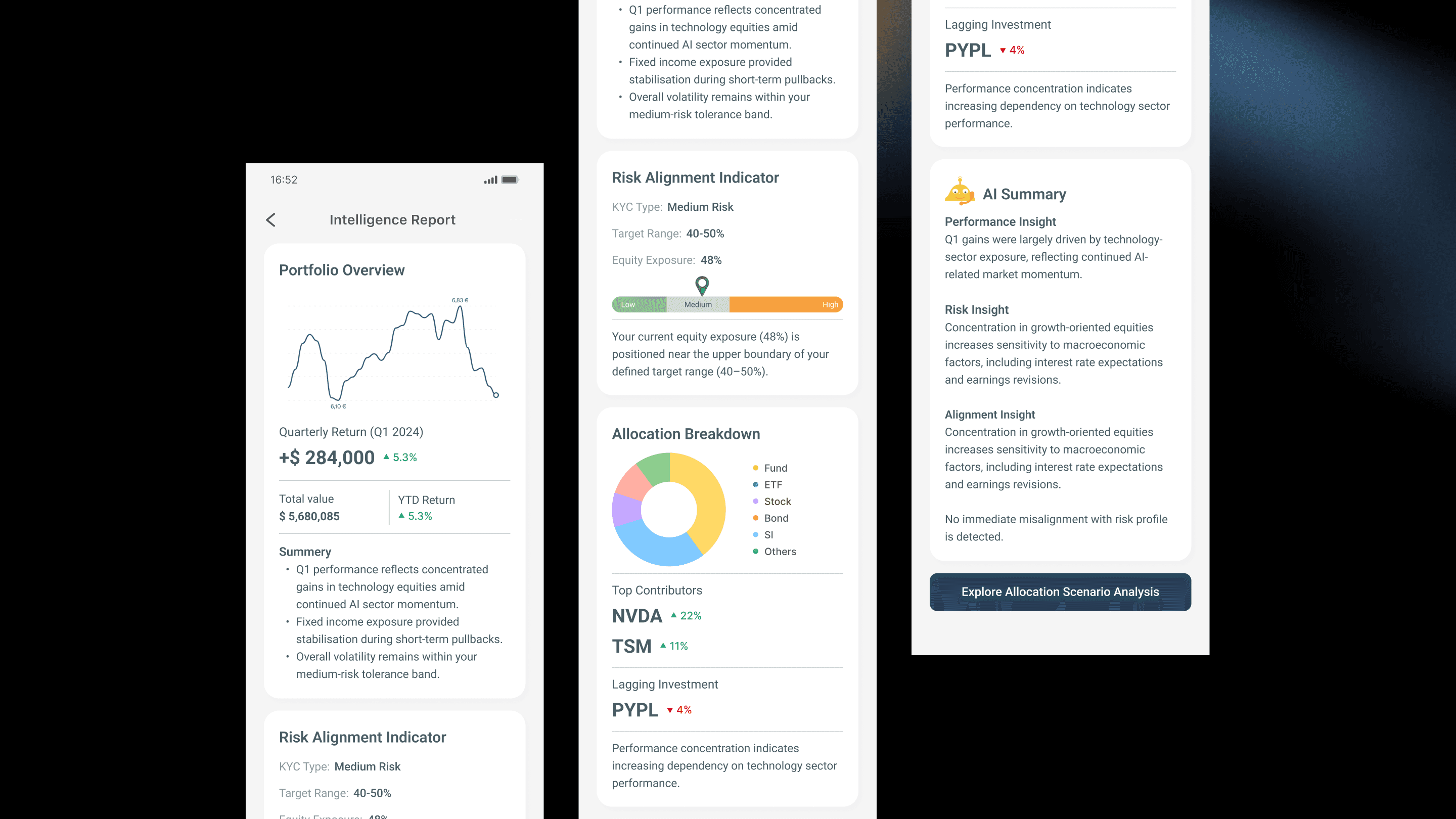
Feature 3 — Portfolio Intelligence Report
The context layer: what to walk in with. Pre-call prep was among the most time-consuming parts of the job, so the report mirrors how account managers already brief themselves: performance trend, risk alignment against the KYC profile, allocation by top holdings.
An AI summary front-loads the analysis; the judgement stays with the account manager.


Try the flow
The design earned its shape
Across 12 client interviews and 8 account manager sessions, three things kept surfacing: signals had to be captured proactively, clients preferred guided choices over free input, and advisors wanted clearer context before reaching out. Each fed a concrete change, from guided option buttons to redesigned context blocks.
Outcome
It shipped inside the bank's existing CRM, so account managers got structured signals without changing how they work. The system runs in their daily workflow — not as another tool they have to remember to open.
Reflection
Design the decision before the screen.
The most important work happened before any screen existed: deciding which signals mattered and how they reached the account manager. Everything visual followed from that.
One system, two users.
Designing for the client and the account manager at once meant modelling the whole signal loop first. Once the system was whole, each feature's role was obvious.
Architecture outlasts the tools.
This was built in 2024, when conversational AI was far more limited — today's agents could handle much of the capture and structuring. What holds up is the decision logic.
